
Difference Between SEO and Generative Engine Optimization (GEO)
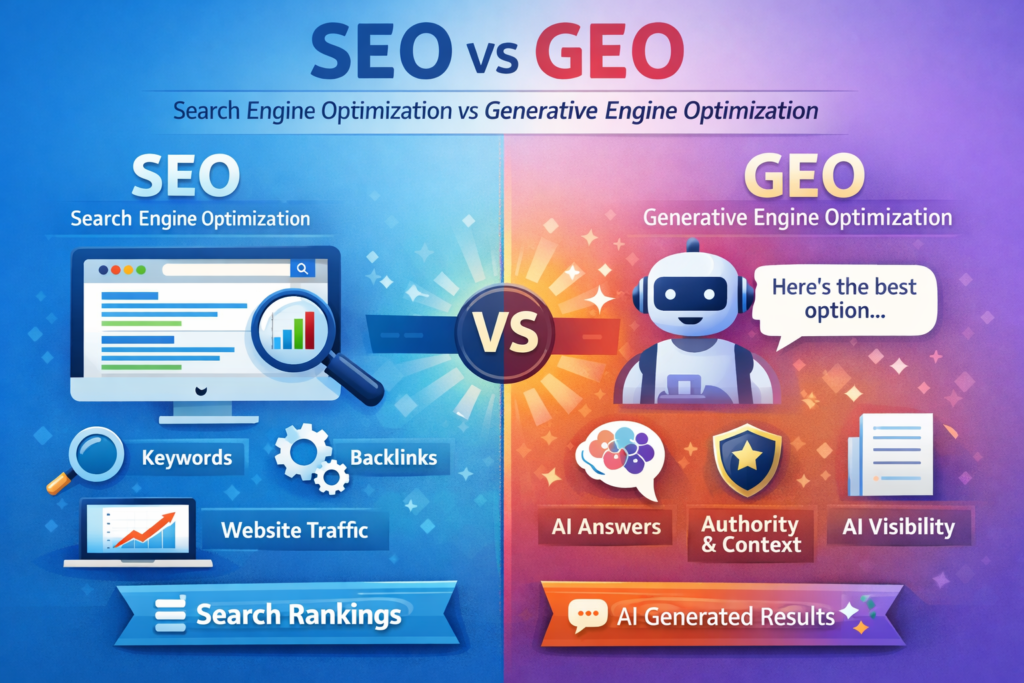
The digital marketing landscape is evolving rapidly. For years, Search Engine Optimization (SEO) has been the foundation of online visibility. Businesses optimized their websites to rank higher on search engines like Google and Microsoft’s Bing. However, with the rise of AI-powered search tools and conversational interfaces, a new strategy has emerged — Generative Engine Optimization (GEO).
Understanding the difference between SEO and GEO is essential for marketers, business owners, and content creators who want to stay ahead in 2026 and beyond.
What is SEO?
SEO (Search Engine Optimization) is the process of optimizing a website to improve its visibility in search engine results pages (SERPs). The primary goal of SEO is to rank higher for specific keywords so users can find your website organically (without paid ads).
SEO involves multiple components:
- Keyword Research: Identifying the search terms users type into search engines.
- On-Page Optimization: Optimizing title tags, meta descriptions, headings, and content.
- Technical SEO: Improving site speed, mobile-friendliness, crawlability, and indexing.
- Off-Page SEO: Building backlinks from authoritative websites.
- User Experience (UX): Ensuring the website is easy to navigate and provides value.
For example, if someone searches “best digital marketing course in Kochi,” SEO helps your website appear among the top results on Google. Users then click your link, visit your site, and potentially convert into customers.
In simple terms, SEO focuses on ranking web pages.
iWhat s Generative Engine Optimization (GEO)?
Generative Engine Optimization (GEO) is the practice of optimizing content so that AI-driven search engines and generative tools reference, summarize, or mention your brand in their responses.
Instead of showing a list of blue links, AI systems generate direct answers. Platforms like ChatGPT, Gemini, and AI-powered search features in Google Search provide conversational responses based on large datasets.
GEO focuses on:
- Structuring content clearly
- Providing direct, authoritative answers
- Building topical authority
- Using entity-based optimization
- Publishing trustworthy, well-researched content
For example, instead of typing short keywords, users now ask full questions like:
“Who is the best digital marketing trainer in Kochi with placement support?”
An AI tool may generate a summarized answer. If your content is optimized properly, your brand may be mentioned within that AI-generated response — even if users never click a website link.
In short, GEO focuses on being included in AI-generated answers.
Key Differences Between SEO and GEO
Although both strategies aim to improve online visibility, their methods and outcomes are different.
1. Focus Area
- SEO: Focuses on ranking web pages in search results.
- GEO: Focuses on being referenced or cited in AI-generated responses.
2. Output Format
- SEO: Produces a list of clickable website links.
- GEO: Produces a conversational answer generated by AI.
3. Strategy
- SEO: Relies heavily on keywords, backlinks, and technical optimization.
- GEO: Emphasizes clarity, structured data, context, authority, and entity recognition.
4. User Behavior
- SEO: Targets users who search using short or mid-length keywords.
- GEO: Targets users who ask detailed, conversational questions.
5. Traffic vs Visibility
- SEO: Drives organic traffic to your website.
- GEO: Builds brand authority and visibility within AI platforms, even without direct clicks.
Should You Choose SEO or GEO?
The smart approach is not to choose one over the other but to integrate both.
SEO remains essential because search engines still drive massive traffic. Technical optimization, keyword research, and backlinks continue to influence credibility and discoverability.
At the same time, GEO prepares your content for the future of search — where AI systems summarize information and deliver instant answers.
To succeed in today’s digital environment, marketers should:
- Create high-quality, structured content
- Answer user questions clearly and directly
- Build strong brand authority
- Use schema markup and entity-based optimization
- Maintain strong SEO fundamentals
ur website, GEO ensures your brand becomes part of AI-driven conversations.
In 2026 and beyond, businesses that adapt to both SEO and GEO will gain a competitive advantage. The future of digital marketing belongs to those who optimize not just for search engines, but for intelligent generative systems as well.